


Unsilencing the Archive
History, Literature, and Myth in Queen Padmini of Mewar
A review by Viniti Yadav
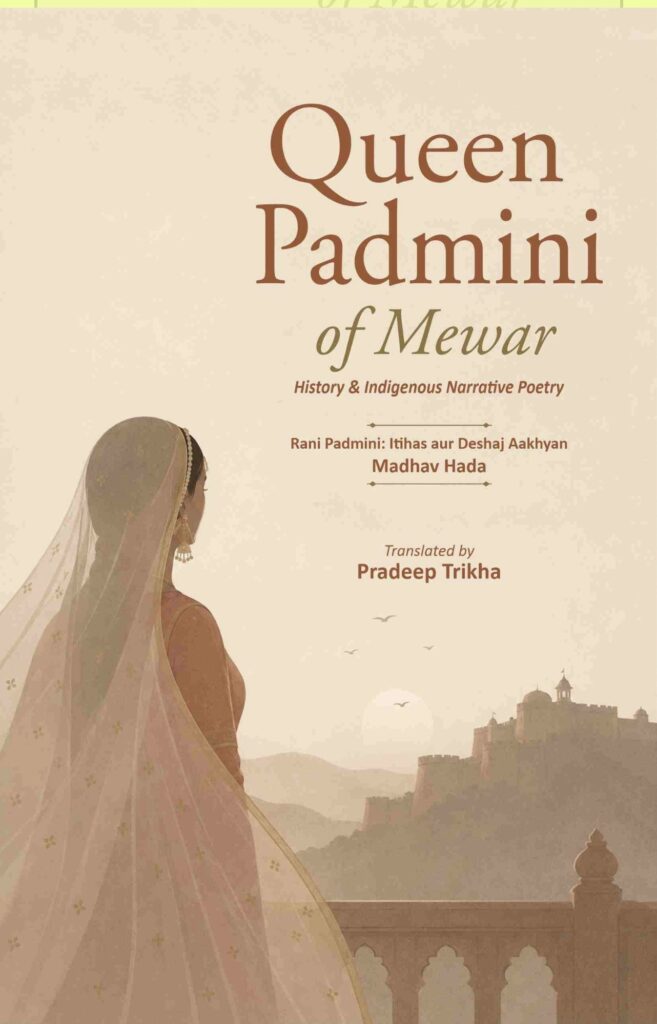
For centuries, the legend of Queen Padmini of Chittor and her self-immolation (jauhar) during the 1303 CE siege of Chittorgarh by Sultan Alauddin Khilji has occupied a central place in the collective memory, folklore, and cultural identity of North-Western India. Yet, within modern academic discourse, her historicity has been fiercely debated and frequently dismissed as mere fiction. In Queen Padmini of Mewar: History & Indigenous Narrative Poetry (translated into English by Pradeep Trikha from Madhav Hada’s Hindi work Padmini: Itihas aur Desaj kavya), Hada presents a rigorous, deeply researched re-examination of the Padmini narrative. This work challenges the long-standing hegemony of colonial and Eurocentric historiography, offering a compelling defence of indigenous Indian textual and oral traditions. The volume is organised into a systematic framework designed to bridge the gap between empirical historical inquiry and indigenous literary traditions.
Critiquing Colonial and Modern Eurocentric Historiography
Hada & Trikha’s primary intervention is an epistemological critique of modern Indian historians who uncritically inherited 18th-century European Enlightenment standards of historiography. European models demand linear causality, strict chronological empirical documentation, and positivist detachment. When colonial administrators such as Lieutenant Colonel James Tod and subsequent scholars such as V.A. Smith, Gauri Shankar Ojha, K.S. Lal, and Kalika Ranjan Kanungo evaluated Indian texts using these criteria, they dismissed indigenous literary narratives as unhistorical myths or mere fabrications.
Hada argues that this approach commits anachronistic violence against ancient Indian historical consciousness. Citing Rabindranath Tagore’s famous metaphor, judging Indian historical poetry by Western empirical standards is like looking for brinjals in a paddy field—and declaring paddy unfit as food simply because it is not a brinjal.
The orthodox dismissal of Padmini rests primarily on a single negative premise: that Amir Khusrau, court poet to Alauddin Khilji who accompanied the Sultan to Chittor in 1303 CE, did not mention Padmini in his work Khazain-ul-Futuh (1311 CE).
Hada, echoing Dashrath Sharma and Harish Trivedi, exposes the logical fallacy of this “argument from silence”: Amir Khusrau wrote as a courtier glorifying his royal patron. Since Khilji failed to capture Padmini alive due to her jauhar, her death represented a moral failure for the invading army. Khusrau routinely suppressed imperial setbacks. Assuming that silence in one source proves non-existence across an entire culture is a flawed hypothesis, not rigorous scholarship.
A prevalent theory among modern historians (such as Kanungo, Irfan Habib, and Harbans Mukhia) is that Malik Muhammad Jayasi completely invented the Padmini narrative out of whole cloth in his Sufi epic Padmavat (1540 CE), and that later Rajput bards merely copied Jayasi. Hada and Trikha thoroughly dismantle this assertion: The Padmini narrative seed (Bijak) existed long before Jayasi. Elements of the narrative are documented earlier in texts like Chitai Charitra (1475–1480 CE). A rich corpus of indigenous texts developed independently across Gujarat and Rajasthan. Works like the anonymous Gora-Badal Kavit (pre-1588 CE), Hemratan’s Gora-Badal Padmini Chaupai (1588 CE), Jatmal Nahar’s Gora-Badal Katha (1623 CE), and Dayaldas’ Rana Raso draw from oral traditions (shruti) and Jain/Charan literary conventions rather than copying Jayasi’s Sufi allegory.
In Chapter 1, traces the historical lineage of Indian narrative traditions from the Rigvedic period. He outlines how historical consciousness was encoded in forms like Narashansi (praise of heroes), Gatha, Akhyan, Purana, and Vansh (genealogies) maintained by Bhrigwangiras clans and Sutas (bards). Over time, these evolved into medieval vernacular genres: Charit, Prabandha, Raso, Khyat, Patnama, and Bahi.
Hada argues that Indian historical awareness embraces both cyclical and linear time. Instead of freezing facts in static documents, the Indian tradition preserved history as “embedded history”—abstracting past reality so that its core ideals remain active, meaningful, and continuous within living community memory.
Hada’s narrative style balances rigorous archival erudition with a deep cultural sensitivity to vernacular literature. Rather than treating literary texts as mere embellishment, he analyses them as primary historical artefacts.
Trikha’s translation retains the analytical rigour of the Hindi original while converting dense historiographical concepts into fluid English prose. The text incorporates modern theoretical paradigms—drawing on Postmodernist and Deconstructionist insights (e.g., Hayden White, E.H. Carr, Romila Thapar) to show that all historical accounts, whether Persian court chronicles or Rajput Chaupais, are structured narratives shaped by ideological perspectives.
Drawing from Romila Thapar’s conceptualisation, Hada contrasts “embodied history” (formal chronological records) with “embedded history” (historical truths woven into epics, genealogies, and folk ballads). Indigenous narrative poems about Padmini serve as vibrant repositories of embedded history that capture the socio-cultural realities of medieval Mewar.
The book addresses the historical marginalisation of female figures in medieval accounts. Citing Virginia Woolf’s A Room of One’s Own, the text highlights the paradox where women pervade poetry and creative imagination yet remain systematically erased from official court records. Padmini’s central agency—her calculated resistance, political intellect, and choice of jauhar to defend personal and communal dignity—is preserved in indigenous texts even when ignored by patriarchal imperial chroniclers. In Chapter 5, the book examines the feudal Kshatriya ethos of medieval Rajasthan. Ideals such as Swamidharma (unyielding loyalty to one’s master), war culture, and martial honour were necessary for survival under external aggression. The legendary exploits of warriors like Gora and Badal are analysed not merely as heroic folklore, but as cultural expressions of ethical duty and resistance.
On the one hand, the book demonstrates high-order erudition by utilising long-neglected regional sources written in Old Rajasthani, Dingal, Pingal, Gujarati, and Awadhi. It provides a robust theoretical defence of non-Western modes of historiography without devolving into uncritical chauvinism. Successfully bridges the artificial divide between literature and history, demonstrating how poetic texts contain valid empirical kernels. Decouples the Padmini narrative from exclusive reliance on Jayasi’s Padmavat, proving the existence of an older, indigenous narrative tradition.
However, the reader is informed in the introduction that the abridged English version excludes direct translations of the indigenous poetic texts themselves and omits Chapter 7 of the original Hindi monograph. Readers seeking the primary poetic verses must refer back to the Hindi edition. The heavy focus on theoretical critiques of historiography and genealogical classification in Chapters 1 and 4 may prove challenging for general readers expecting a straightforward biographical narrative of Queen Padmini.
Pradeep Trikha’s translation of Madhav Hada’s Queen Padmini of Mewar: History & Indigenous Narrative Poetry is a landmark contribution to Indian historiography and literary criticism. By recentring indigenous, regional voices and dismantling the reductive “silence = non-existence” logic of colonial scholarship, Hada restores Queen Padmini to her rightful place at the intersection of history, literature, and living memory. It is an essential read for scholars of medieval Indian history, postcolonial theory, and vernacular literature.
About the author(s)
