
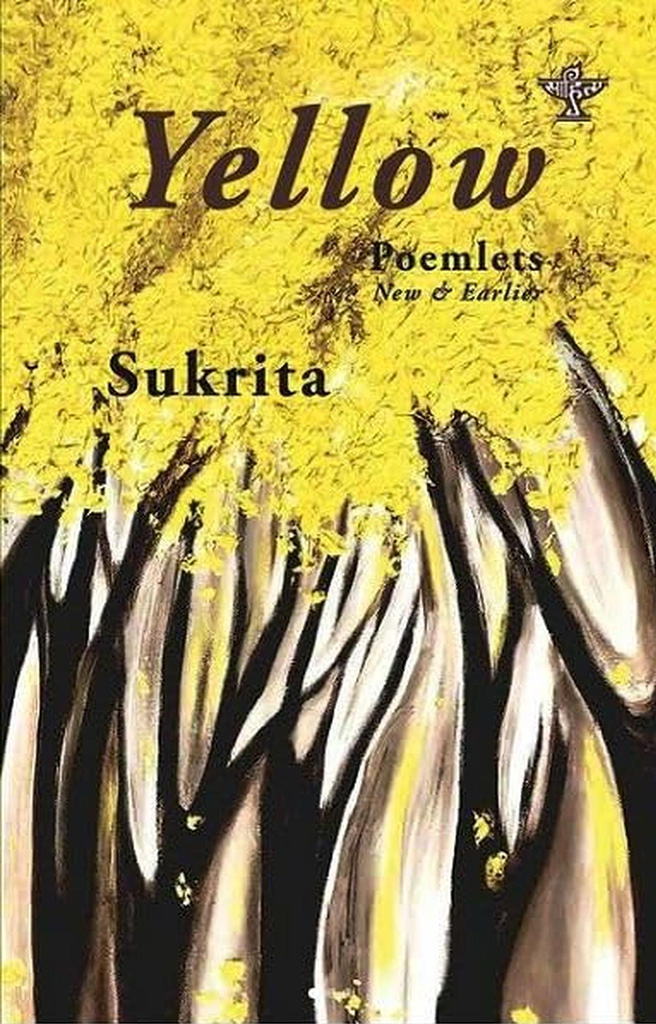
A Review of Sukrita’s Yellow by Tamoghna Mukherjee
In his seminal work On the Heights of Despair (1934) Emil Cioran famously wrote, “After having struggled madly to solve all problems, after having suffered on the heights of despair, in the supreme hour of revelation, you will find that the only answer, the only reality, is silence.” It won’t be preposterous to say that this very insight of Cioran materiaises in Sukrita’sYellow: Poemlets New & Earlier (2024). A collection of short, succinct, yet intense poems Yellow not only resonates with the idea that a profound poetic journey usually carves a new way from chaos to harmony, from cacophony to silence, but also celebrates life as the quintessence of poetry. It is a collection that doesn’t lose itself in the mere practice of juxtaposing incongruous words but lets them breathe. With minimalist yet meticulous strokes, Sukrita creates an inner landscape where emotions and thoughts mingle with each other, where memory and presence conjure a vibrant yet serene poetic space.
The contemplative usage of the term “poemlets” instead of “poems” efficiently reflects Sukrita’s philosophical stance vis-á-vis her predilection for brevity. As she herself asserts in the preface, the term “poemlets” suggests a certain kind of incompleteness, “at least till such time as [the poemlets] locate a home in the reader’s mind and get a sense of wholeness.” However, a meditative reader may discover that this “sense of wholeness” that the poet longs to attain is akin to the presence of Buddha in this collection. She writes, “filled with sadness/ big shining tears/ roll down the/ mountains as springs/ and fountains// into Buddha’s lap.”
The titular “yellow,” the colour often associated with warmth, energy, and passion, takes on a wide range of shades here— hope, rejuvenation, decay, caution, and luminosity. The tender touch of solace can be found in poemlets like “i see her now/ only when i close my eyes/ on the screen that is dark/ illuminated by her appearance.” Besides, her sincere approach towards the river Ganga in “dialogues with ganga” reflects her quest for peace as well as the rootedness that moulds the texture of identity. Her dialogue with the river, despite all those negative aspects of life that recur throughout the series, ultimately celebrates rejuvenation and resilience: “o ganga,/ i am ready to/ perform my life again….” However, Yellow is not all about inner peace and inward journey, it also casts light upon the socio-political unrests and the drudgery caused thereby— “bullet marks on the walls/remnants of war// unhealed people in homes behind.” The alarming reality appears with an unwelcomed silence— “more live than the forlorn dog/ are the shadows of bullets on the walls of iprin// deep craters on the earth/ hold silence/born of the boom.”
What makes Yellow more nuanced is not only the way it deals with the personal or the ecological aspects but also the political perspectives—though never in an overt or argumentative way. Displacement, identity, and the agony of border-crossing bleed through the verses. “Who can cross the border and return/ who can rise from the ashes of the pyre/ can the corpse walk out of the grave,” she utters, in a voice that carries empathy though not overpowered by sentimentality. These are not loud protests but quiet acknowledgements—verses that bear witness to lives often left out of history, allowing the nameless to be seen, if only briefly, in the mind’s eye.
Interspersed with the poemlets are silence and memory—the two recurring motifs that predicate the vicissitudes of life throughout the collection. The familial memories of her parents appear in several poemlets, where the parents are portrayed not as distant figures but as deep imprints in her psyche. On the one hand, the warmth of her relationship with her father becomes alive when her words commemorate, “his palm rests/warm and throbbing/ over my head/ his blessings travel deep/ into my veins with the promise/ to sustain me forever;” on the other hand, lines like “womb is a natural gufa/ of creation// and it is a tomb/ of all memories” quite efficiently indicate the ability of human psyche, especially feminine psyche, to become a reservoir of memory. In addition to this, silence plays a pivotal role in the collection and can remind one of the poems of Paul Celan and Eugene Guillevic. Here, silence is not presented just as the absence of sound, but as a zone of transition and transcendence— “silence is the stillness of the universe/ all movement evolves from there.”
In conclusion, it can be inferred that Yellow excels as a collection of poemlets for the precision of imagery and the emptiness between the lines that holds just as much meaning as the words themselves. Like the pause between musical notes or the space between breaths, the silence in Sukrita’s poems remains alive. And owing to all these factors, Yellow appears as a book that can change you in ways you can’t immediately perceive. It urges you to listen—to the world, to others, to the self—and to understand that poetry is not always in what is said, but often in what is left unsaid.
Source: Yellow: Poemlets, New and Earlier. Sukrita. Sahitya Akademi. Rs. 200



Leave a Reply